Musings from a lean stack: The timeout you borrowed is breaking a feature you forgot
A profile import failed for everyone for four days without a single crash or alert. The cause was a 12-second timeout borrowed from another feature. Caller-owned limits, dumb-but-reliable fallbacks, and alerts for polite failures.
Part 4 of 5 in the series **Musings from a lean stack: notes from building and running software alone, on one server and a small budget.
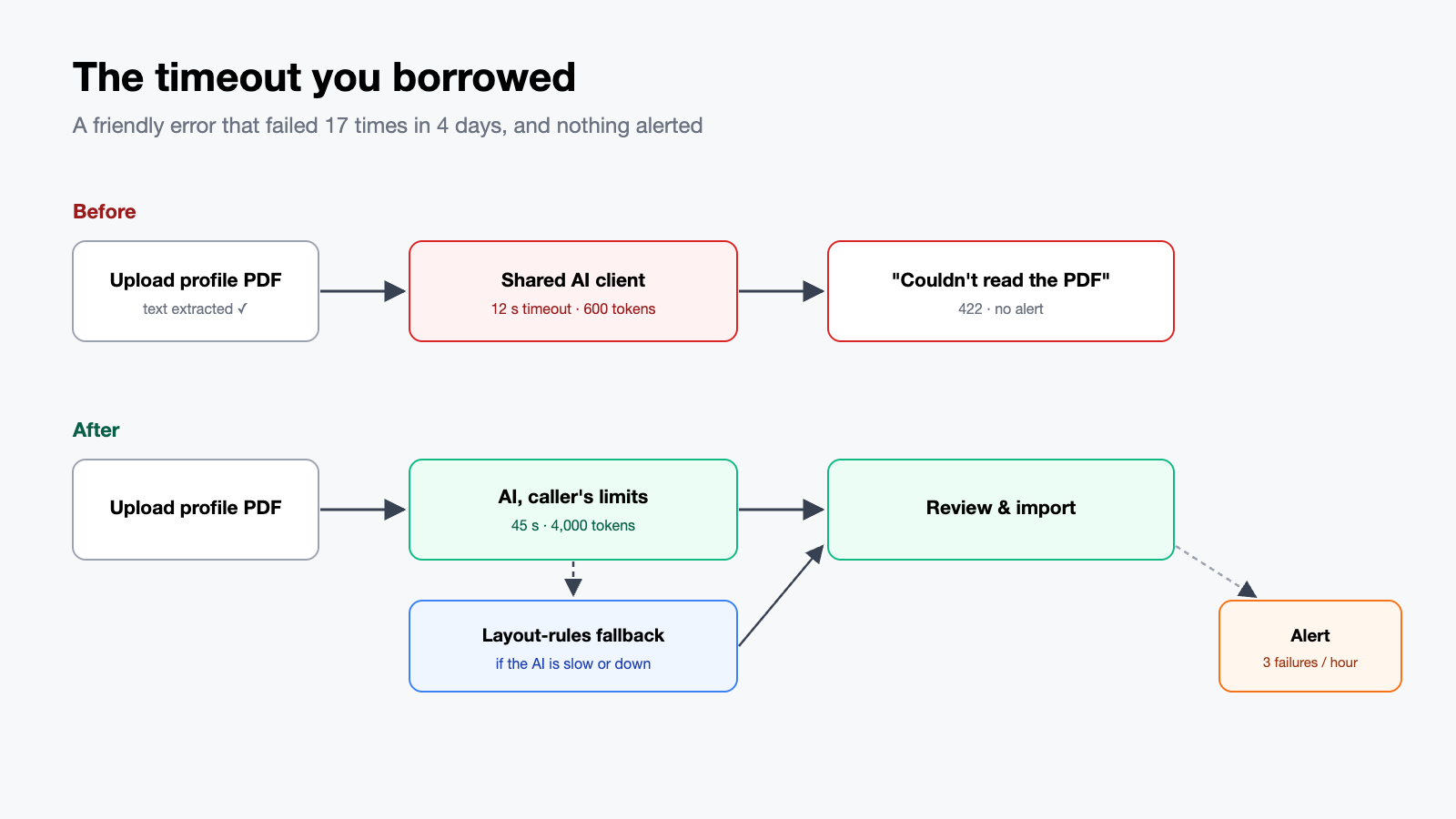
Some bugs crash a page. Those are the easy ones, because something tells you. The bug I want to write about never crashed anything. It just politely told every single person who tried a feature that it didn't work, for four days, and nothing alerted me.
The complaint
A member of my social app sent a message: they tried to import their LinkedIn profile from the PDF LinkedIn lets you download, and the app said it couldn't read the PDF.
I checked the logs expecting a broken file. Instead, every PDF import over the previous four days had failed, seventeen attempts in all, each with the same line:
[ProfileImport] AI: ApiError: provider unreachable: Net::ReadTimeout
Completed 422 Unprocessable Content in 12229ms
Twelve seconds, every time.
The cause: a timeout borrowed from a different feature
The importer reads the text out of the PDF, then asks an AI model to sort it into jobs, education, skills and so on. It reused the same small AI client I'd built for content moderation, which made sense at the time. Moderation calls are short: "is this post OK?" gets a one-line answer in a second or two. So the client had sensible defaults for that job: give up after 12 seconds, and allow a reply of about 600 tokens.
A whole career history is a different job. The model needed longer than 12 seconds to answer, and even a fast answer would have been cut off at 600 tokens, which isn't enough to hold a full profile. So the shared client failed in a perfectly reasonable way, for a use it was never tuned for.
Timeouts and size limits are product decisions, and they belong to the caller. A default that's right for one feature can be wrong for another.
Fix 1: let the caller choose
module AiClient
  DEFAULT_TIMEOUT = 12   # right for quick verdicts
  DEFAULT_MAX_TOKENS = 600

  def self.ask(system:, user:, timeout: DEFAULT_TIMEOUT, max_tokens: DEFAULT_MAX_TOKENS)
    http = Net::HTTP.new(ENDPOINT.host, ENDPOINT.port)
    http.use_ssl = true
    http.open_timeout = http.read_timeout = timeout
    # ... build the request with max_tokens and send it
  end
end

# The importer asks for what it actually needs:
AiClient.ask(system: PROMPT, user: profile_text, timeout: 45, max_tokens: 4000)
Fix 2: don't let one dependency be a single point of failure
The second change mattered more. If the AI is slow, down or switched off, the feature shouldn't die with it. LinkedIn's PDF has a predictable layout: a sidebar (contact, top skills, languages, certifications) and a main column (name, headline, summary, experience, education), with date ranges like "March 2022 - Present (2 years 9 months)". That's enough to write a plain rule-based reader as a fallback:
DATE_RANGE = /\A(?:(\w+)\s+)?(\d{4})\s*[-–]\s*(?:(Present)|(?:(\w+)\s+)?(\d{4}))/i

def positions(lines)
  lines.each_with_index.filter_map do |line, i|
    next unless (m = line.match(DATE_RANGE))
    { title: lines[i - 1], company: company_above(lines, i), current: m[3].present? }
  end
end

def read(text)
  from_ai(text) || LayoutReader.new(text).call   # AI first, rules if it fails
end
The fallback isn't as clever as the model. It doesn't need to be. It turns "nothing works" into "this works a bit less well", and the member reviews everything before it's saved anyway.
Fix 3: alert on failures that don't crash
My crash alerts never fired because nothing crashed. The controller caught the error and showed a friendly message, exactly as designed. So I added a second kind of alert: count real failures per feature, and tell me when one keeps failing.
module FeatureFailure
  def self.record(feature, reason)
    count = Rails.cache.increment("failures:#{feature}", 1, expires_in: 1.hour)
    return if count < 3
    AdminAlert.notify(key: "feature:#{feature}",
                      title: "#{feature} keeps failing (#{count} in the last hour)",
                      detail: reason)
  end
end
The important part is deciding what counts. A member uploading the wrong kind of file isn't a failure of the feature, so that raises a separate MemberError that never counts. A timeout or a bad answer does count.
What it cost
People asked whether reading a profile with AI was expensive enough to restrict. With a small model, one import costs a fraction of a US cent, and the fallback costs nothing. The money was never the problem. The silence was.
Lessons
- Shared clients need caller-owned limits. Pass timeouts and size limits from the feature, not from whoever wrote the client first.
- Give every external dependency a fallback, even a dumb one. Less-good beats broken.
- Friendly errors need alarms too. If the user sees an apology, you should see a count.
- Read your 4xx logs, not just your 5xx. A wall of identical 422s is a bug wearing a polite face.
Comments
Keep reading
Nov 19, 2026 · 5 min · Ruby on Rails
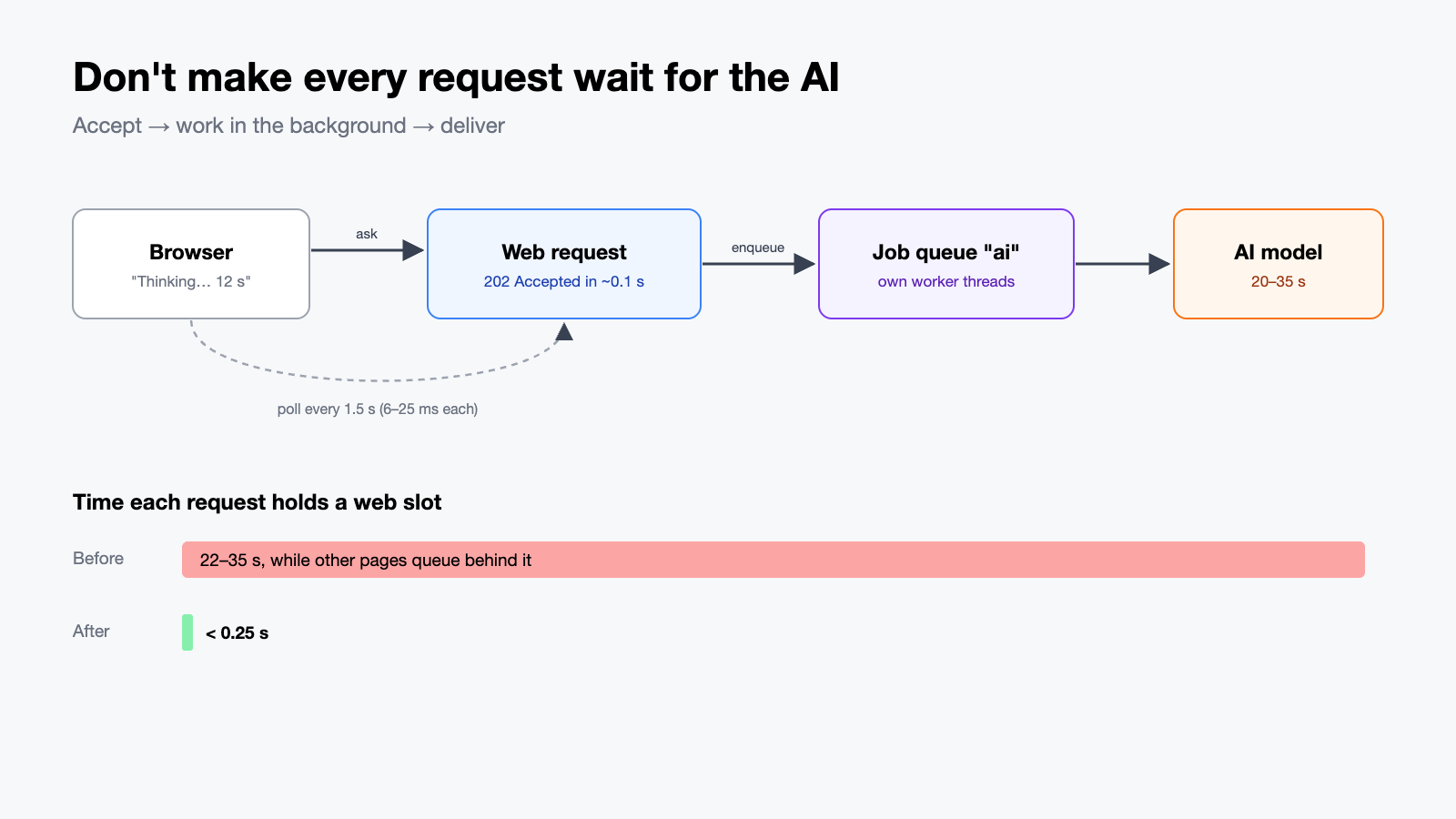
Musings from a lean stack: Stop making every request wait for the AI
AI features held a web request open for 20 to 35 seconds, so a few people asking at once could stall everyone. Accept, work in the background, deliver: the pattern, a Rails sketch, and the details that make waiting feel fine.
Nov 18, 2026 · 8 min · Ruby on Rails
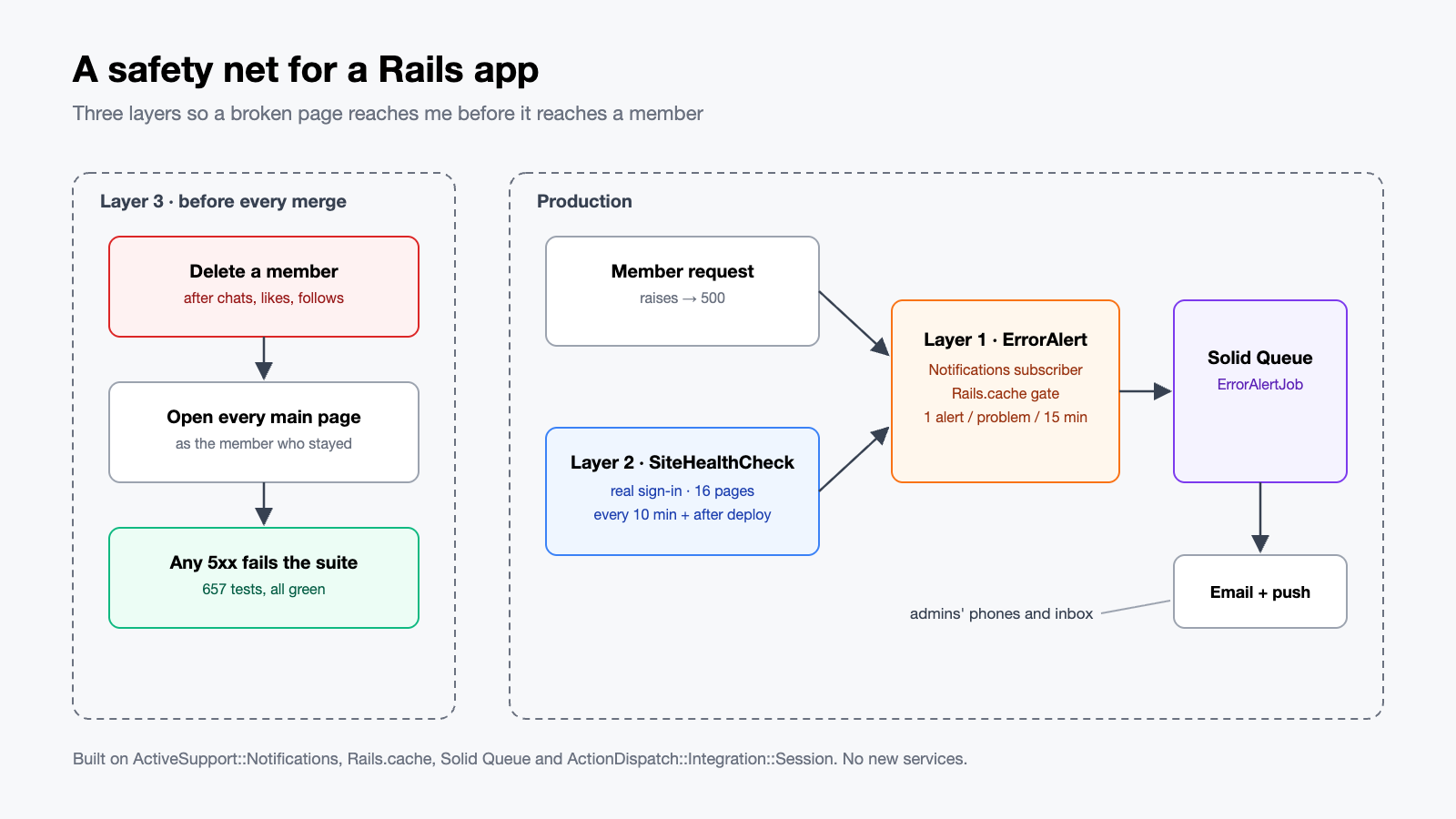
Getting Brethreign ready for launch: one deleted account broke my inbox
A deleted test account left a chat with nobody in it, and the inbox crashed. I heard about it from a person, not a tool. The fix took minutes; the safety net I built that evening uses only Rails: crash alerts, a self-checking robot and a test for the people who leave.
Jul 22, 2026 · 2 min · Ruby on Rails
Beyond Rails: How to Handle Real-Time & WebSocket-Heavy Apps
ActionCable is fine. But when you need to handle 10,000+ concurrent connections, you need a different beast.
Leave a comment